Game server hosting from $4 a month
Pay, and your Minecraft server builds itself while you read the confirmation email. Hosted in Europe on machines we own, with a panel that does the jobs you would otherwise open a ticket for.
Cancel from your order page whenever you like. If you’re coming from another host, we do the move and it’s free.
Powered Not yet Empty bayDrag the floor, or use the arrow keys
Minecraft server hosting plans
Minecraft
Paper, Purpur, Folia, Spigot, Vanilla, Forge, NeoForge, Fabric, Quilt, BungeeCord, Velocity, Waterfall and Sponge. Pick the software and the version at checkout, and it is built and started for you.


Or set the numbers yourself
Memory, cores, disk and backup slots each have a price on them. Drag, watch the total, order it. Nobody is going to call you about a quote.
12 GB RAM – 4 vCPU – 100 GB disk – 10 backup slots
What the world and its plugins live in
Dedicated threads, not a shared pool
Worlds, jars, logs, and stored backups
How many restore points you can keep at once
- Memory12 GB × $1.25 / GB
- $15.00
- vCPU4 cores × $1 / core
- $4.00
- Disk100 GB × $0.05 / GB
- $5.00
- Backup slots10 slots × $0.25 / slot
- $2.50
- Control panel, address & portflat
- $1.50
The three listed sizes are bundles, so one of them usually beats the same shape built by hand. When that happens we say so above and link you to it.
Asking for a build does not charge you. We check the spec, set it up, and send a payment link once you’re happy with it.
Want hardware we do not stock, or a setup that spans more than one machine?Talk to engineering
Everything happens in the panel
Plugins, players, files, console, backups, server software, restart schedules. It runs in a browser, it is the same on the $4 server as on the $18 one, and the jobs that normally mean an FTP client or a support ticket are two clicks.
- Plugins install themselvesSearch Modrinth, click install, it’s on the server
- Live player listOp, kick, ban and whitelist without touching the console
- Switch server softwareChange the loader or the version yourself
- A real file editorTabs, syntax highlighting, no FTP client
- Console and startupRead the output, type commands, set flags and restarts
- Backups you runTake them and put them back, up to your slot count
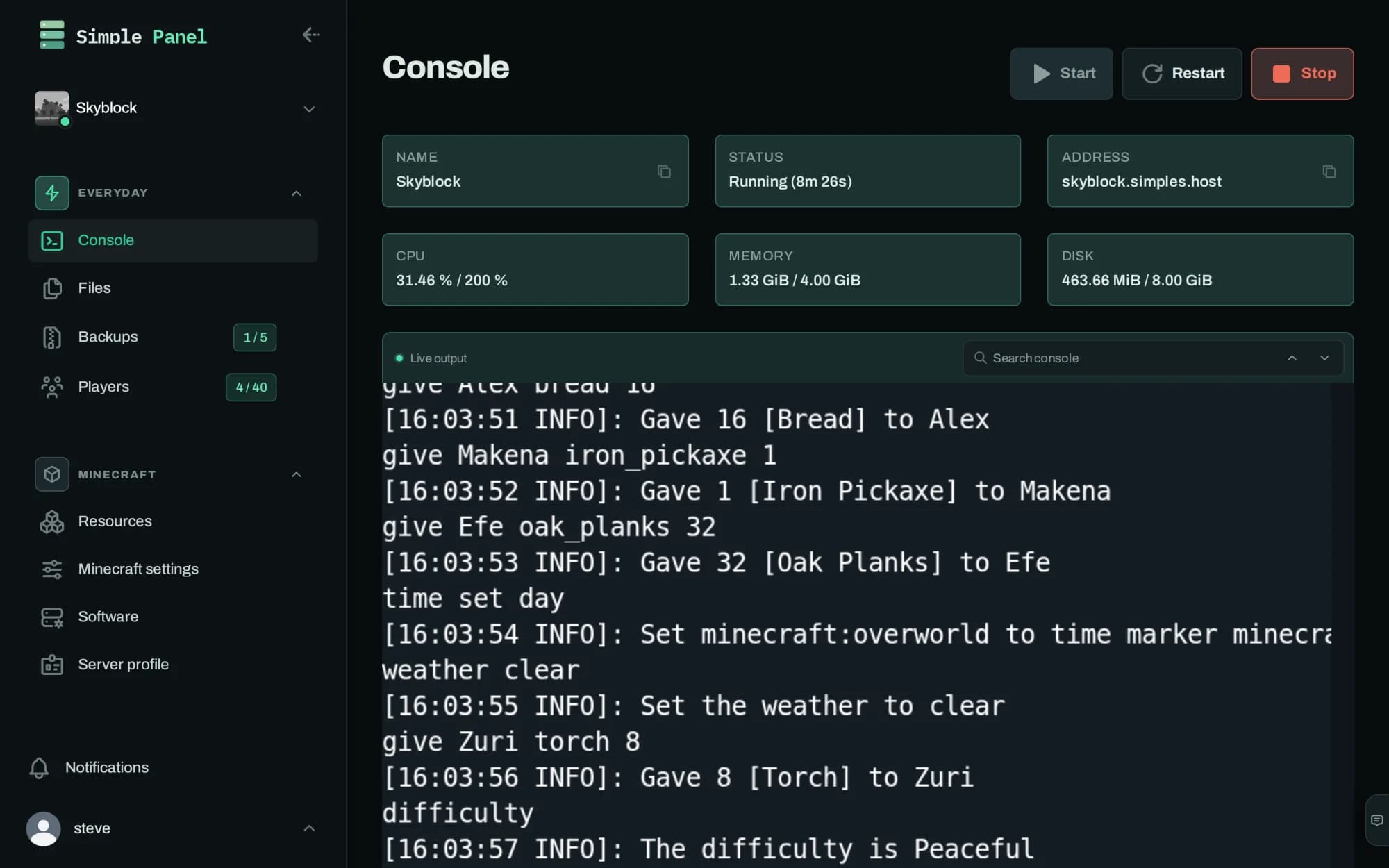
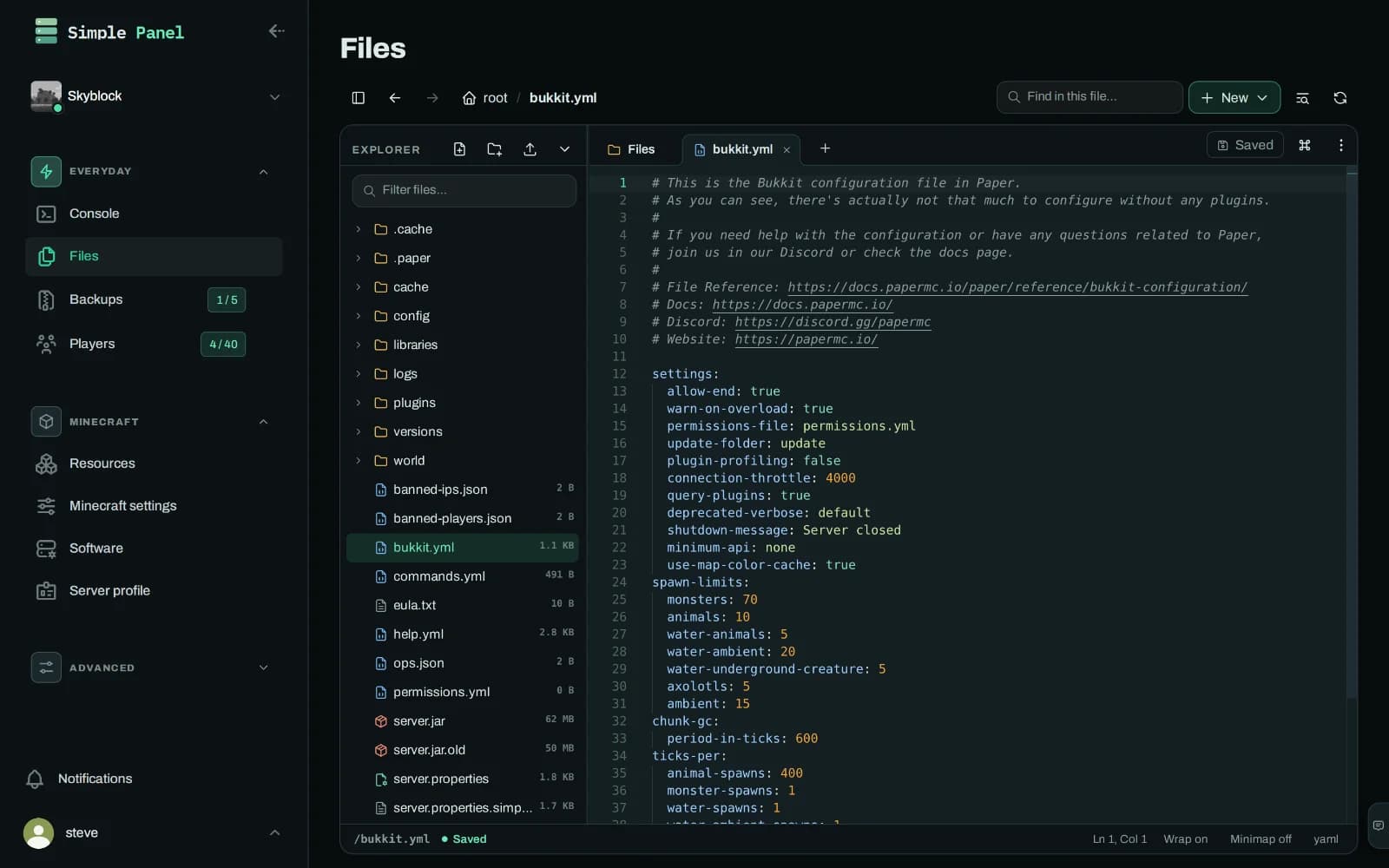
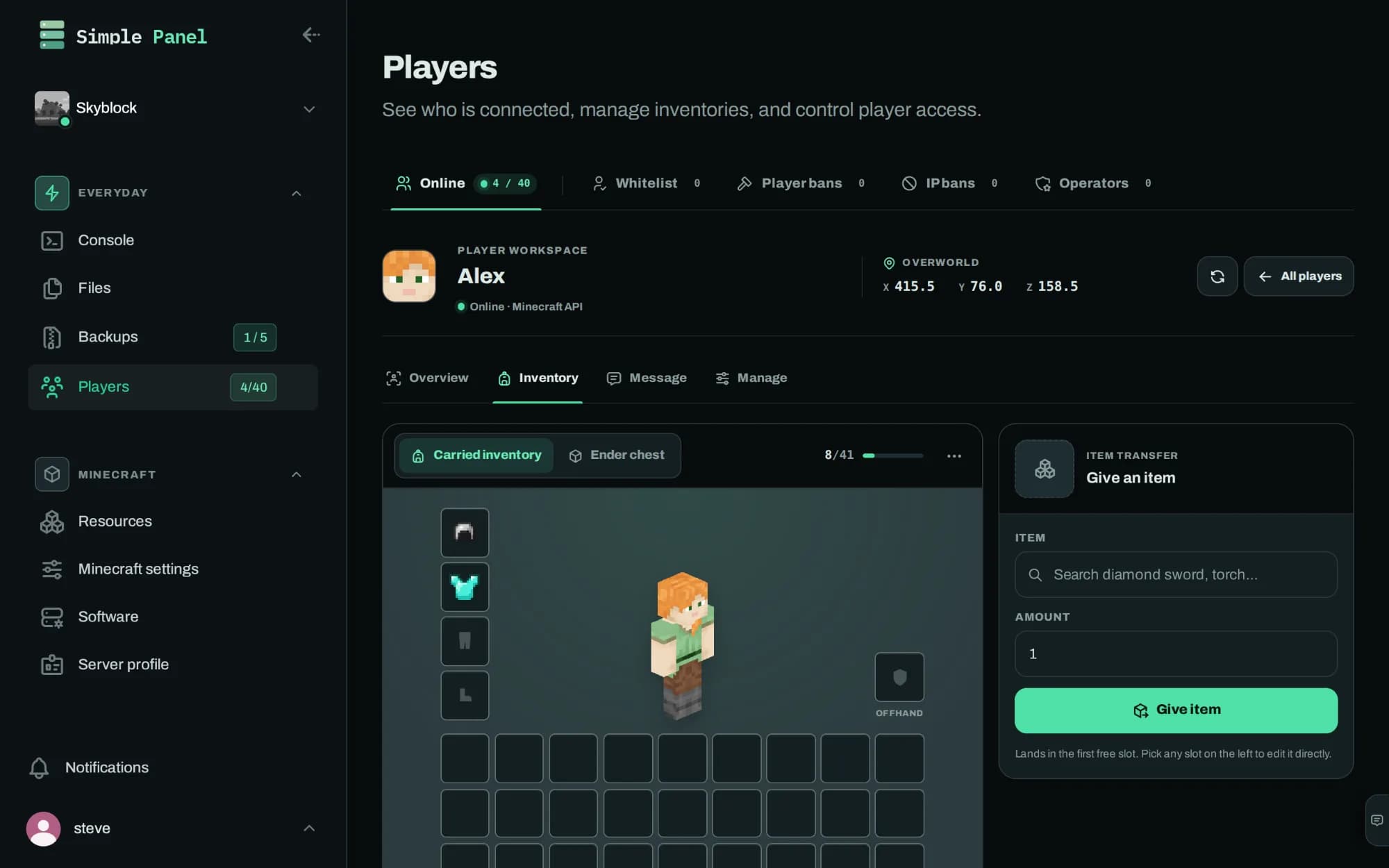
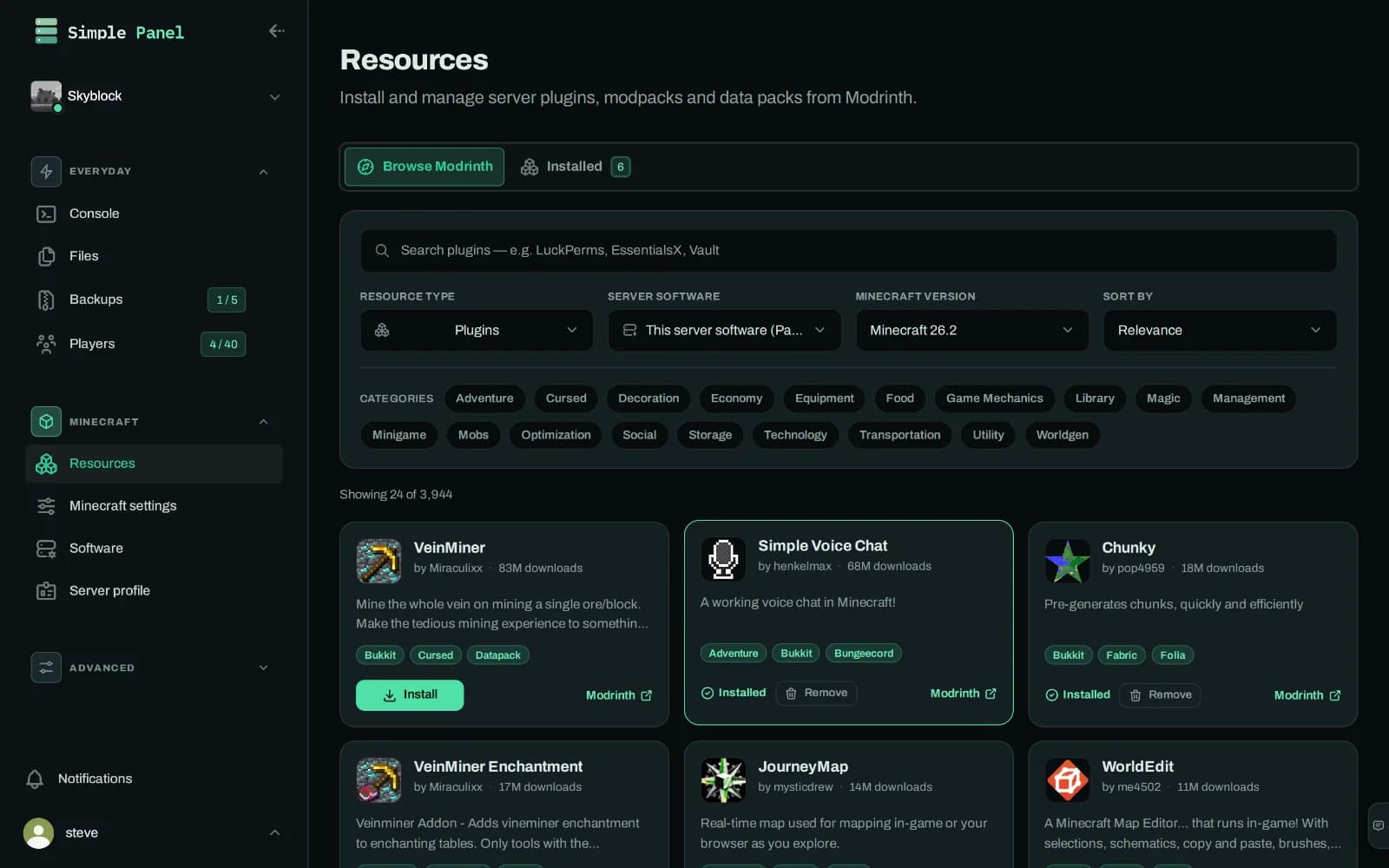
Screens from the panel, on a server that is running. Press a button to change which one.
The same on every plan
What you pay buys memory, cores and disk. The rest of it is identical whether you’re on the $4 server or the $18 one.
- Setup
- Stripe confirms the payment and the server builds itself: allocation, port, files, the lot. The jar is down in about 25 seconds and a vanilla world is answering pings around the two minute mark. A big modpack takes longer on its first boot, because it has to generate everything.
- Your address
- Pick a subdomain at checkout and people connect to yourname.simples.host. The port is still underneath if you ever want it.
- The panel
- Console, file manager, backups, startup flags, scheduled restarts, resource graphs. The $4 server gets exactly the same one as the $18 server.
- Server software
- Paper, Purpur, Folia, Spigot, Vanilla, Forge, NeoForge, Fabric, Quilt, BungeeCord, Velocity, Waterfall and Sponge. Pick one at checkout, swap it later from startup settings.
- Your limits
- Memory, cores, disk, databases and backup slots are fixed numbers on your server, and nobody else is drawing from them.
- Backups
- Take one and put it back yourself, up to your slot count.
- If a payment fails
- We suspend the server rather than delete it, and keep a snapshot you can download from the panel while you sort the card out.
- Billing
- Monthly, through Stripe. Cancel it from your own order page and it runs to the end of the month you have already paid for.
We write the server too
Loom, the Minecraft server we write
Loom is our multithreaded Minecraft server, built on Paper so your Bukkit plugins run unchanged. Same world, same load, same Java, same twelve cores. Paper uses about one and a third of them. Loom uses all of them. It is GPLv3 and written in the open.
See the benchmarkA tick has a 50 ms budget. Above that the server is behind, and players feel it as rubber-banding and lag.
How ordering works
Pick a size
Off the rack, or build one on the sliders.
Pay for the first month
Stripe handles it. Nothing exists before the payment clears, and nothing is charged after you cancel.
It builds itself
Server, allocation and subdomain, all automatic. The address arrives by email.
Open the panel
Set the software and version, start it, send the address to your players.
Measured, on a vanilla server: the panel account and the address exist about a second and a half after the payment clears, the jar is down at twenty-four seconds, and it answers a client ping at just under two minutes. Modpacks are slower, and it is the first world generation that costs the time.
Anything the sliders can’t do, ask us
The configurator builds a server on our floor. Past that, write to us. Your own hardware, a country we don’t have a hall in yet, several machines that have to behave like one: all of it is fair game, and an engineer reads the brief.
Migrations
Send us the details for your current host. We move the world, the plugins, the configs and the databases, boot it, check it over, and switch the address across when you say go. Free on every plan, including the $4 one.
Hardware you pick
A particular CPU, more memory than the sliders go to, dedicated disk, or a whole node with nothing else on it. If it can be bought and racked, we will price it.
Somewhere else
One hall in Europe today. If your players are elsewhere, say where, and we will quote that site honestly with the latency written down.
More than one machine
A proxy in one region, game nodes in another, a shared database behind them, private networking between the pieces. We design it, stand it up, and hand you the panel.
Send a brief
A person reads theseQuestions people actually ask
The server exists the second Stripe confirms your payment, and the address is emailed straight after. The jar downloads in about 25 seconds, and a vanilla world answers a client ping around two minutes in. A large modpack takes considerably longer on its first boot, because it has to generate everything before it lets anyone in.
Only Minecraft is powered right now. The other racks are specced and waiting on demand, so if you want one, say so and it counts toward getting it built.
Yes. The configurator prices memory, cores, disk and backup slots separately, so you can build a size that isn’t one of the three listed. If a listed size already covers your build for less, it says so and links you across.
All three, through the engineering desk rather than the configurator. Particular CPUs, dedicated nodes, countries we don’t have a hall in, setups that span several machines. Migrations are free on every plan and we do the moving.
A subdomain, picked at checkout: yourname.simples.host. Nobody has to memorise five digits.
Forge, NeoForge, Fabric and Quilt are all there. Upload packs through the file manager, and change the loader or the version from startup settings whenever you like.
We suspend the server and keep a snapshot of it. You can download that from the panel, and pick the world back up if you come back.
Open your order page, hit Manage billing, cancel. It runs to the end of the month you have already paid for.